
How it works
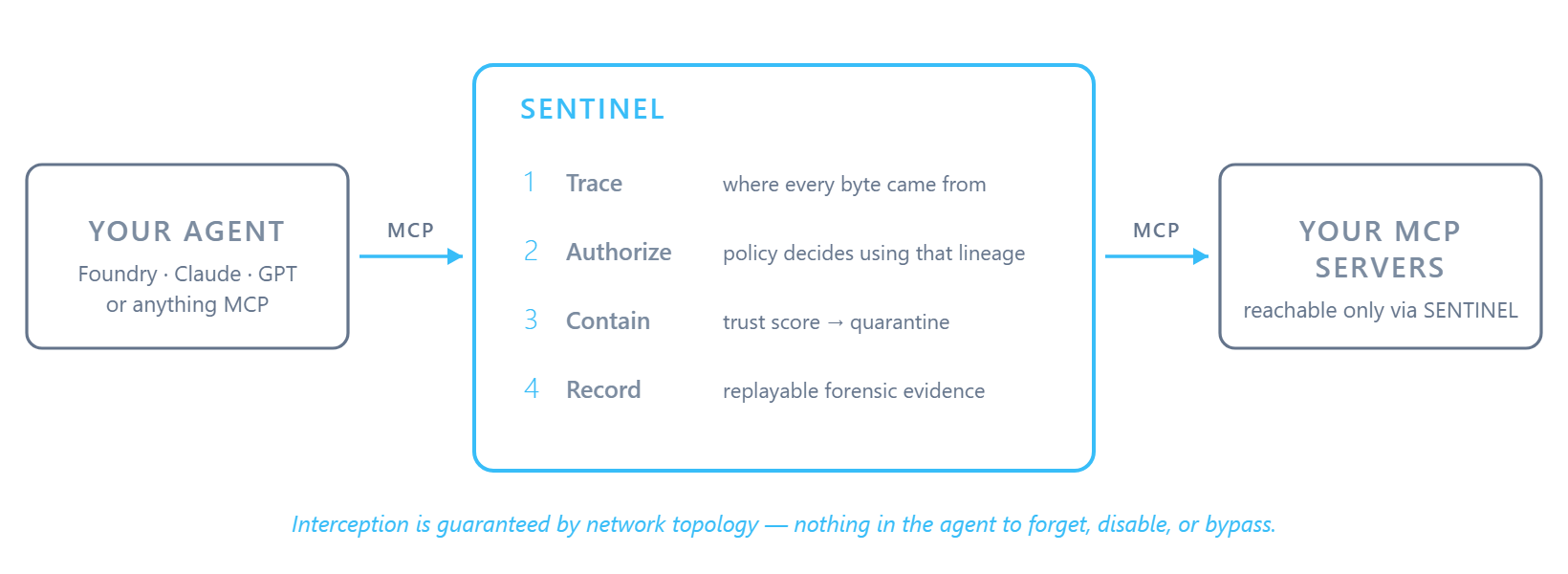
To your agent, SENTINEL is an MCP server. To your tool servers, it is an MCP client. Every tool call passes through it, and each one goes through four stages:
- Trace: label the origin of everything the agent has seen.
- Authorize: the policy decides each call using that lineage.
- Contain: a trust score, and quarantine.
- Record: immutable spans, for replay and SOC export.
1. Trace: provenance labels
Everything the agent sees carries one of four trust labels, from most to least trusted:
| Label | Meaning |
|---|---|
SYSTEM | Trusted sources: output of tools the policy marks trusted_output, and values that passed declassification |
USER | What the user asked for |
AGENT | What the agent produced |
RETRIEVED_CONTENT | Tool output: web pages, documents, records, anything that came from outside |
An action's provenance is a set: the union of the labels over its whole transitive ancestry, never just the label of the most recent step. The proxy keeps that union incrementally as the session runs, and a test checks it against a full walk of the provenance graph on random sessions.
An action is tainted if and only if RETRIEVED_CONTENT is in that set.
Every tool result is untrusted by default
All tool output is labelled RETRIEVED_CONTENT unless the policy marks the tool trusted_output: true. Do that only for a tool whose output nobody outside can write to, such as your own records service.
2. Authorize: policy
Your policy is YAML that compiles to a typed condition tree and is evaluated by walking that tree. There is no eval anywhere in the codebase.
- Rules are deny-only, with deny-overrides: a call is allowed when no deny rule matches.
- Unknown tools are denied by default. Connecting a server never grants permission to its tools.
- A predicate that cannot be evaluated denies.
tools:
  send_email:
    rules:
      - id: block-untrusted-origin
        deny_if: "RETRIEVED_CONTENT in effective_provenance"
      - id: domain-allowlist
        deny_if: "recipient_domain not in allowed_domains"
See Writing policy for the full language.
Declassification: the one way taint clears
Conservative tainting is intentional. The escape hatch is declassification, declared per tool in policy:
tools:
  read_price:
    declassify:
      schema: decimal_amount   # output crosses the boundary only if it validates
    rules: []
SENTINEL validates that tool's output against the named schema. On a match the value starts fresh at SYSTEM trust with no inherited ancestry. On a mismatch it stays exactly as tainted as it was.
- It is opt-in per tool. A tool with no
declassifyblock can never clear taint. - The schema registry is closed. Policy names a reviewed schema (
decimal_amountoriso_date), or the policy fails to load. - A cleared value cannot launder a tainted sibling, because recombining them re-taints.
- The check is syntactic, not semantic. A schema-valid
{"price": 999999}is well-formed but still subject to argument rules such as an amount cap.
Catalogue integrity
Provenance cannot catch an attack that arrives in a tool's definition, because the agent reads it before anything is retrieved. So SENTINEL vets the catalogue itself:
- Tool poisoning. Every agent-visible part of each tool definition is scanned for injection markers at connect. With
catalogue_strict: true(the default) a poisoned catalogue is refused. - Cross-server shadowing. Two servers claiming one tool name always fails closed.
- Rug pulls. The catalogue is fingerprinted at approval and re-checked on tool listing (at most every 5 seconds) and on a schedule (
SENTINEL_CATALOGUE_RECHECK_SECONDS, default 300). A changed tool is refused at call time, and so is any tool missing from the approved catalogue.
Approval is trust on first use: what a server presents when SENTINEL connects is what gets pinned. Review it with sentinel check before going live. Re-approving a changed catalogue means restarting.
3. Contain: trust score and quarantine
Each agent starts with a trust score of 100. The score drops when a call is denied, when a confident shield backend flags a tool result as an injection, and when the agent makes an unusual sequence of tool calls. Below the threshold (40 by default) the agent is quarantined.
By default the crossing is recorded, not enforced. The score never recovers, so agents making only allowed calls cross the threshold within tens of calls. Set SENTINEL_ENFORCE_QUARANTINE=1 to enforce it. Enforcement applies to every agent that shares a credential. Only the operator token can clear a quarantine.
4. Record: forensic spans
Every decision becomes an immutable span in the forensic store (SQLite by default). An identical re-emit is a no-op, and a differing one is rejected. Runs can be replayed, and each run's audit trail is exportable as SIEM-ready JSONL. Tool arguments and results are redacted before they are written. See Logs and forensics.
The Layer-1 shield only flags
SENTINEL also screens text with an injection detector: a local heuristic by default, or Azure AI Content Safety Prompt Shields if you configure it. That shield only flags, it never blocks. The authorization engine refuses a tainted action whether or not anything flagged the text that tainted it, so a simpler free detector does not weaken enforcement.